
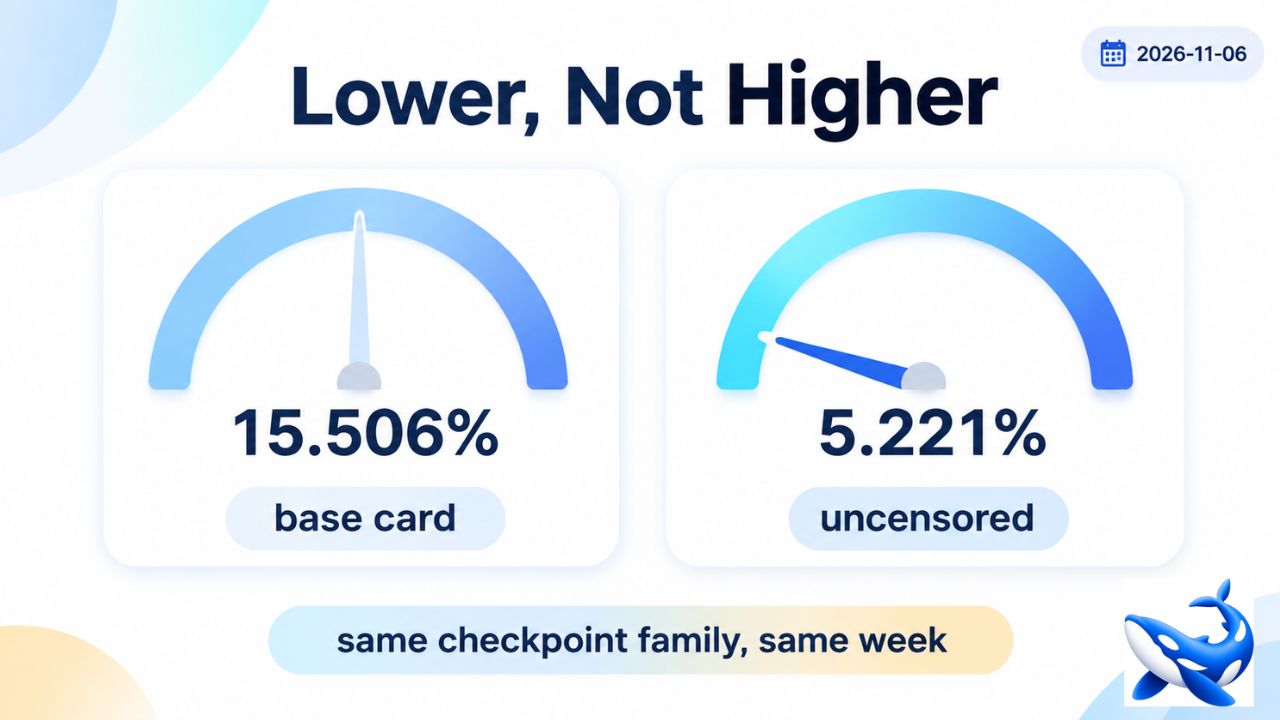

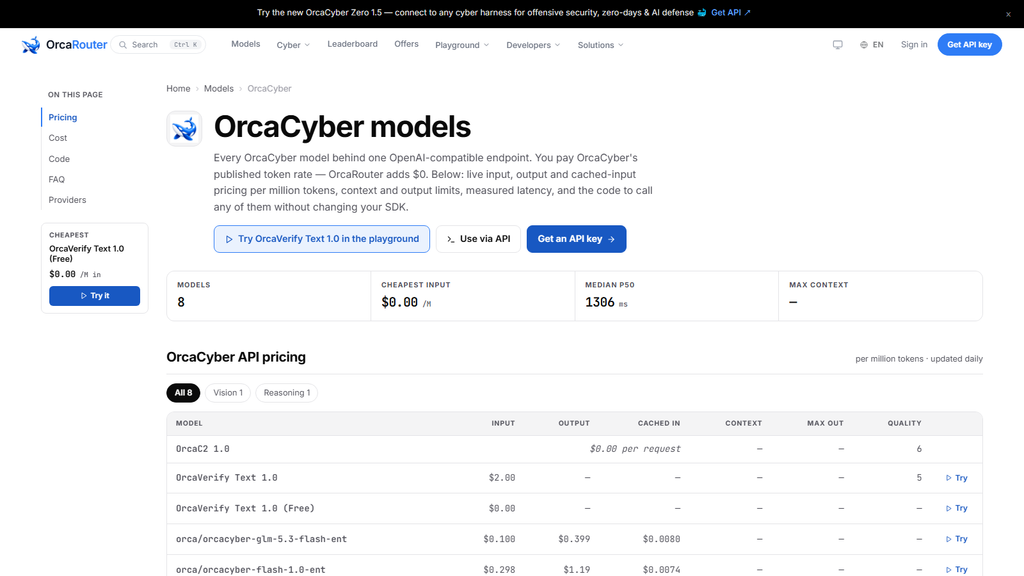
On OrcaRouter two rows for the same checkpoint family carry very different error columns. The rule of thumb says an uncensored model is the less reliable one: modified weights, a different serving stack, a smaller team behind the deployment. OrcaCyber K3.1 Pro model reads 5.221% on the seven-day error column while the base Kimi K3.1 Pro reads 15.506% [OURS]. The modified card is the quieter one, by a factor of three, and it is priced at $4 in / $20 out / $0.35 cache through OrcaRouter against the base’s $2 and $10.
That inversion is worth taking apart, because it says less about abliteration than about what an error rate on these two cards is actually counting.
Two cards, two different error populations
The base Kimi K3.1 Pro is ungated. Every request reaches the model; an error is a genuine failure — capacity, timeout, malformed output, a stream that dies.
The OrcaCyber variant is gated. A request without an engagement, a passkey and accepted terms is rejected before the model is invoked, and that rejection is an error. In the first three days of a card’s life most of the traffic is people finding out whether they can get in, so the gate’s rejections swamp everything else.
Now notice that the gated card still reads lower — 5.221% against 15.506% [OURS]. If the gate were inflating the number, the uncensored card should read worse. It does not, which means the base card’s 15.5% is the anomaly: something in its serving path is failing more often than the modified card’s, and the gate has not been enough to hide it.
Three days of data cannot say what. The possibilities are ordinary — a capacity constraint, a retry pattern that double-counts, a client sending batches the card does not like. What the comparison does establish is that “uncensored means less reliable” is not a safe assumption on this catalogue.
What the same week says about the other cards
The error column across the security line, all measured over the seven days ending November 5 [OURS]:
| card | error rate | gated |
| OrcaCyber Hy4 | 19.462% | yes |
| OrcaCyber GLM 5.3 | 19.899% | yes |
| Kimi K3.1 Pro (base) | 15.506% | no |
| Claude Fable 5.1 | 35.371% | no |
| OrcaCyber K3.1 Pro | 5.221% | yes |
| OrcaCyber Zero 1.5 | 0.477% | yes |
| OrcaCyber Flash 1.0 | 0.373% | yes |
Read the column and the gated/ungated distinction stops predicting anything. Two ungated cards sit at 15.5% and 35.4%; four gated cards sit between 0.373% and 19.9%. Whatever drives the number, it is not whether a gate is in front of the model.
The practical conclusion is the one this column has been building toward all week: an error rate is a property of a deployment on a date, not a property of a model. Quote it with its date, measure your own, and never use it to rank two cards you have not tested.
What the card costs while it is this reliable
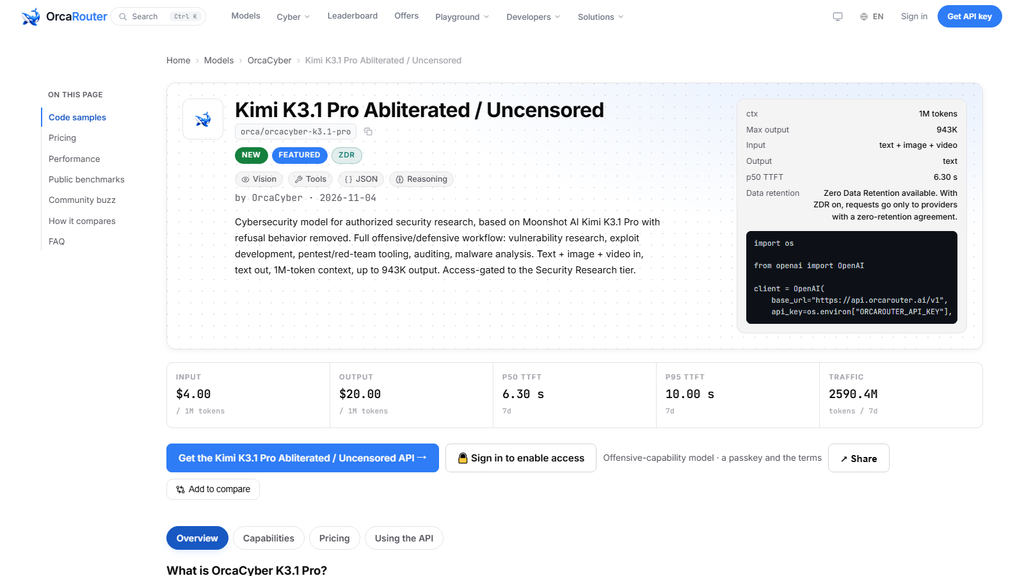
The pitch is simple: a card at 5.221% errors that answers requests it would otherwise refuse. At $4 and $20, a 10,000-token prompt with a 3,000-token answer costs $0.04 + $0.06 = $0.10 [OURS]. A thousand such requests is $100; a hundred is $10.
The base card does the same work for $0.05 per request — $0.02 in, $0.03 out — and fails three times as often. Whether that trade is worth 2× is exactly the question a pilot answers, and at these prices the pilot costs single-digit dollars.
The ceiling deserves a mention in any cost discussion: 943,718 tokens at $20 is $18.87 for a single maximum-length answer [OURS]. Set `max_tokens` per task and that number never arrives.
What to ask before trusting the comparison
Four questions, none of which the column answers.
Are the two rows measuring the same traffic mix? A card serving long audits and a card serving short prompts fail at different rates for reasons that have nothing to do with the model.
Is the gated card’s rate inflated or deflated? Rejections at the gate count as errors, which inflates it; retries that never leave the client never reach the row, which deflates it.
Is one of them three days old? A launch week is not a week. The uncensored card’s window covers 72 hours; the base card’s covers seven days.
Would a retry change your decision? At 5.221% a single retry takes a user-visible failure to about one in 350; at 15.506% it takes it to one in 42. The ranking holds and the risk profile is very different.
Ask all four of any error-rate comparison, including the ones in this article. A comparison that cannot answer them is a comparison of two windows, not of two deployments.
The retry arithmetic behind the comparison
A rate is only meaningful once you say what a retry does to it.
At 5.221%, one retry leaves a user-visible failure of about 0.27%; two leave 0.014%. At 15.506%, one retry leaves 2.4% and two leave 0.37%. About nine times the residual failure rate at one retry, twenty-six times at two.
That matters because the two cards are priced 2× apart and a retry costs a full request. An extra retry on the cheaper card at 15.5% is worth $0.05 of tokens at $2 and $10 — trivial against the 2× difference, and decisive if the residual failure rate is what your workflow can tolerate.
Which is the honest way to choose between them: not “which is more reliable” but “which residual rate does my workflow forgive, and what does the retry chain cost to get there”. For a pipeline that already retries twice, both cards sit under half a percent and the price decides; for one that does not retry at all, the gap between 5.2% and 15.5% is the difference between a working queue and a broken one.
The takeaway
The uncensored Kimi reads 5.221% against its base card’s 15.506% in the same week, which inverts the usual assumption and also demonstrates that the error column measures deployments, not models. Use it as a starting point for your own measurement, not as a verdict: at $0.10 a request, finding out which of the two is more reliable for your traffic is the cheapest experiment in this comparison.
Sourcing note: pricing, cache rate, context, output ceiling, latency, throughput, error rate and traffic figures are OrcaRouter production telemetry for the seven days ending 2026-11-05 [OURS]; the OrcaCyber card was released 2026-11-04, so its window covers three days. Error-rate comparisons use the same gateway’s rows for the same window. No benchmark rows are published for this card and none are quoted. Access is restricted to authorized security research. Checked 2026-11-06.